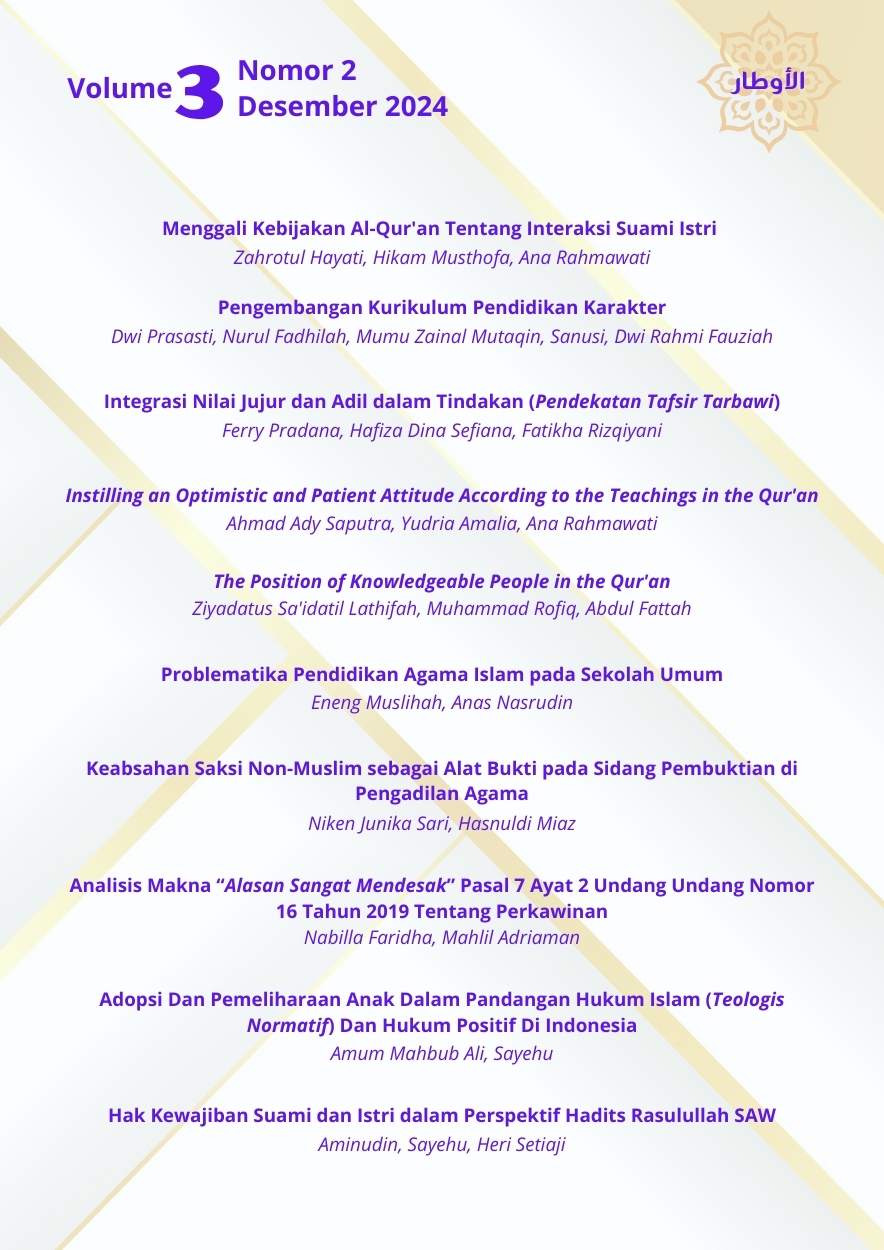
The The Validity of Non-Muslim Witnesses as Evidence During at Evidence Sessions in Religious Courts
Keywords:
Islamic Law; Evidence; Religious CourtsAbstract
The Qur'an does not provide a detailed explanation of the requirements for a witness, thereby necessitating further research to determine the criteria for the acceptance of testimony as evidence in a court of law. The predominant opinion among Islamic legal experts (fuqaha) is that non-Muslim testimony is not admissible in cases pertaining to Muslims. The primary principle that is applied in religious courts is the Islamic personality principle. Accordingly, the requirements pertaining to the Islamic faith of a witness in a religious court stand as a subject of discourse. The research method employed is normative juridical, encompassing positive civil procedural law and the Civil Code. The nature of the research is analytical-descriptive. The compulsory presence of Muslim witnesses at evidentiary hearings in religious courts is not a viable solution, as the panel of judges in these courts is primarily tasked with finding formal truth. As long as non-Muslim witnesses presented by the litigants meet the formal requirements, specifically by reciting an oath according to their respective religions and beliefs prior to testifying, and as long as the witness can provide information regarding an event that he has personally witnessed and heard directly, non-muslim witnesses, when deemed competent by the court, may offer valid evidence during evidentiary hearings in religious courts, provided they adhere to certain criteria. Specifically, these witnesses must be able to provide firsthand knowledge or information derived from direct observation or auditory perception of the event in question. It is essential to emphasize that the testimony of non-Muslim witnesses is not to be considered as a substitute for direct evidence originating from the litigants themselves. Rather, it is to be regarded as an additional source of information that may contribute to the overall understanding of the events in question, provided that it is not based on assumptions or personal beliefs.
Downloads
References